Kacper Urzykowski
Senior Manager, Advisory Practice Lead w Future Mind, a Solita Company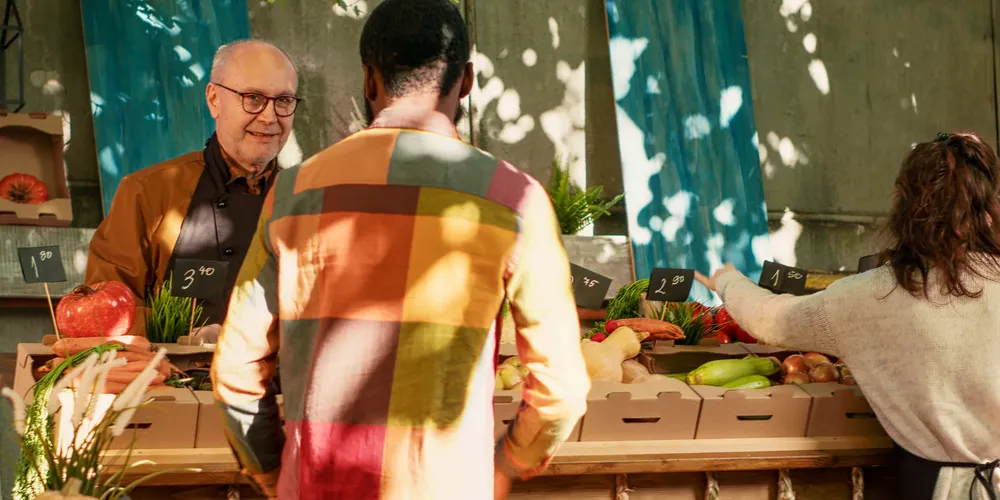
While working on this article, I found myself reflecting on why customers come back – and what lies ahead when there’s no longer a human on the other side.
Let’s imagine a marketplace in ancient Rome. A merchant named Lucius sells olive oil. He knows each of his regular customers by name. He knows that Titus always shops on Fridays, before the Sabbath, because his neighbor is Jewish. He knows that Flavia prefers amphorae from Baiae, because her husband claims the oil tastes better. Lucius doesn’t run a loyalty program. He simply remembers.
Now let’s jump ahead two thousand years. 1981 – American Airlines launched AAdvantage, the first modern loyalty program based on miles. 2025 – the Starbucks app has over 30 million active members in the United States alone and accounts for more than half of the chain’s transactions. The journey from Lucius to Starbucks is a story of growing scale and diminishing intimacy – and our challenge has been to rebuild that intimacy, this time using data.
The history of loyalty programs spans several eras: airline miles were followed by stamp cards in cafés (“buy 9, get 1 free” – brilliant in their simplicity), then plastic point cards, and later digital apps with gamification and push notifications. Each era introduced new tools, but the core question remained the same: why should a customer come back?
When we talk about loyalty, we often confuse the tool with the goal. The goal is to get the customer to come back. A loyalty program is just one way to achieve that. And customers return for five reasons – it’s important to understand how they differ.
Cheaper. This is the simplest driver. Discounts, cashback, points converted into real money. I have a Żabka card, so I go back to Żabka. IKEA Family gives me 10% off selected products, so when I think about buying a pillow, I think IKEA. This mechanism works, but it’s costly and fragile – all it takes is a better offer from a competitor, and loyalty disappears overnight.
Faster. Amazon Prime built an empire on this. It’s no longer just about price – it’s about getting your package tomorrow, not next week. Express checkout in apps, scan-and-go, pre-ordering coffee for a specific time. Speed creates loyalty through convenience.
Closer. A gas station on the highway doesn’t have to be great – it just has to be there. But in 2025, “closer” is more than geography. It’s about being available in the customer’s preferred channel: WhatsApp, an app, a voice assistant. It’s about being present in the ecosystem the customer already lives in.
And this is where the objectively measurable world ends. Because there are two more reasons – and they’re completely different.
More enjoyable. How do you measure enjoyment? You don’t – you can only observe it through proxies: NPS, time spent in the app, frequency of return.
Enjoyable can mean a beautiful interface, a friendly cashier, background music, the smell of fresh bread at the entrance to a bakery. It’s subjective and deeply personal.
Exceptional. This is the top of the pyramid. When Nordstrom calls a customer to let them know about a new collection because “we remember you were looking for a coat in this color last fall” – that’s exceptional. I feel seen by the brand. Not as a number in a database, but as someone with a name, a story, and preferences.
That’s why personalization is one of the most important concepts in loyalty marketing today – not because it’s trendy, but because it’s the only way to achieve scalable uniqueness.
Data is fuel. But fuel without an engine doesn’t go anywhere.
For years, we collected transactional data: what was bought, when, and for how much. Then came behavioral data: what was clicked, what was viewed, where attention lingered. Now we’re entering the era of contextual data: where the customer is, what the weather is like, what they listened to earlier, what they’re interested in. Combined with machine learning models, this allows us to predict with remarkable accuracy what a customer will want – sometimes before they know it themselves.
Spotify Wrapped isn’t a feature. It's proof of love. Every year, millions of people wait for the moment when the platform tells them: “this year, you listened to 47,000 minutes of music, and your favorite artist was X.” This is data transformed into emotion. And that’s what personalization at its highest level is about.
But there’s a catch. Personalization without warmth feels like surveillance. A customer who receives a notification saying, “We see you’re near our store – stop by for your favorite coffee,” might feel either uniquely cared for or closely watched. The line is thin, and it depends largely on the trust the brand has built beforehand.

Let’s go back to Lucius and his olive oil.
Lucius knew everything about his customers, but he served maybe thirty of them. At its peak, Tesco Clubcard had 19 million active members in the UK alone. You can’t know everything about 19 million people, but you can extract patterns from the data that closely replicate what Lucius knew intuitively. That’s the beauty of modern loyalty programs: they scale micro-level knowledge to a macro level.
But there’s something data can’t tell you. Lucius could see that Titus showed up in tears that day. He knew it wasn’t the moment to sell – it was the moment to give something for free and ask, “Are you okay?” He knew that because he was a human talking to another human.
The most successful loyalty programs, the ones that last, understand that data is the map – but the relationship is the territory. Decathlon may have a great app, but its real strength lies in employees who run, cycle, and genuinely connect with customers. Marriott Bonvoy may have a profile for every guest, but when a receptionist remembers you prefer a high-floor room away from the elevator – that’s loyalty.
And here’s where we make a leap that could reshape the entire conversation about loyalty.
Throughout history, from Lucius to Starbucks, loyalty has been a human-to-human relationship. A merchant and a customer. A brand and a consumer. Even if algorithms stood on the brand’s side, there was always a human on the other end, someone who either felt special or didn’t.
What happens when there’s an algorithm on the other side too? Already today, AI assistants shop on our behalf. AI agents compare insurance offers and choose the cheapest policy. In a world where purchasing decisions are made by AI rather than humans, what does loyalty even mean?
We can imagine four models of interaction:

This is not science fiction. It’s a question every loyalty marketing team will have to face within the next three to five years. And there is a paradox here: for millennia, we have tried to understand humans. Mapping their emotions, preferences, and behavioral patterns. We succeeded. And now we are faced with a new question: what does “exceptional” mean to AI – and perhaps we will find ourselves back at the starting point: trying to understand an entity that makes decisions, has “preferences,” and operates within a specific context. Only this time, instead of a name there will be an endpoint – and instead of a feeling, a vector in latent space.
Regardless of the era, tools, or technology, loyalty comes down to one question: do I, as a customer, feel that you (the seller) care about me?
Lucius knew this 2,000 years ago. Spotify knows it today. And whoever – or whatever – will be asking about loyalty in 20 years’ time will still need to answer that same question.
Data is the fuel. Technology is the engine.
But the direction is set by what we still call humanity.

J. Nawrocki - Lead UX Researcher

I. Franke - Head of Advisory

P. Wasilewski - Head of Solutions

M. Michałowski-Żuk - Customer Experience Manager