Emil Waszkowski
VP of Commercial Development
Autonomous stores promised the ultimate convenience: no queues, no waiting for a cashier, and no worrying about locked doors late at night. Consumers could simply walk in, shop, and leave whenever it suited them. And yet, Amazon has now closed all of its Amazon Go and Amazon Fresh stores. Does that mean society simply isn't ready for checkout-free retail?
This could lead to the rushed conclusion that autonomous stores are nice in theory but a disaster in practice. But the problem isn’t necessarily the format itself, but rather, what it’s trying to compete against: beloved, well-established convenience stores in local neighborhoods, where shopping habits already run deep, along with the hot gossip and the occasional dog to pet. Trying to change those ingrained habits was always going to be a challenge.
But businesses can work with those habits instead of against them. So if local neighborhoods are out, where can the autonomous stores settle down?
The answer lies in liminal spaces. Checkout-free stores can feel like a blessing when you're stuck at an airport late at night, waiting in a hospital lobby for yet another hour, or passing through a train station between destinations. These are places where people are away from their familiar surroundings and routines, making them ideal for checkout-free retail.
In short, the problem with autonomous shopping isn’t that people dislike it or that it’s too difficult to use. It’s simply better suited to places with a steady flow of people who value speed and convenience over choice.

To drive the point home, let’s take a look at what didn’t work and why.
Auchan shut its one autonomous store in Warsaw, which had been running since July 2023. It was operating on a busy, popular road, competing with other household names that didn’t require downloading an app and figuring out how to make purchases. In these cases, stopping by staffed stores was the more convenient option, removing the worry of blaring alarms or technical issues. At the moment, Auchan has suspended opening any more autonomous stores as of May 2026.
Carrefour offers another example. The retailer closed both of its self-service stores in 2024. One was located in a shopping mall, surrounded by other retailers where browsing, wandering, and discovering new things were all part of the experience, turning shopping into a form of entertainment. The other store operated in a commercial building, again alongside conventional retailers. For many consumers, the convenience of entering a familiar store and waiting briefly in a queue outweighed the effort of reading instructions, downloading an app, or learning how to enter and pay at an autonomous store. This was especially true for customers with children waiting in the car or with other errands to complete, for whom speed and simplicity mattered more than the novelty of a cashierless experience.
Neither Auchan nor Carrefour learned the right lesson. But someone else did – Żabka.
While Żabka Nano still has roughly 50 shops running, the company itself now says the format works best in restricted or semi-restricted environments (factories, offices, hospitals, universities, airports) and is pulling back from open, public retail locations. As pointed out by the chain’s press office:
“The Żabka Nano format allows us to respond flexibly to customer needs and how a store is received by customers in a particular location. We anticipate several new store openings, but we are also considering relocating some of the existing stores. (...) This year, the chain’s priority is to develop so-called specialized locations – stores accessible to specific groups of customers, such as employees of individual manufacturing plants or residents of student dormitories.”
Meanwhile in Germany, Lekkerland – the convenience specialist owned by REWE Group – successfully operates more than 20 unmanned shops. Their location of choice includes loading parks, hospitals, railway stations, office complexes. More recently, it took the same model into Frankfurt Airport's Terminal 1 arrivals area: a 70-square-metre, roughly 570-item REWE To Go shop where AI-powered cameras track what customers pick up, and the amount is charged automatically to whatever card was scanned on entry. It also opened a cashierless REWE To Go at a railway station in Koblenz.
What makes these spaces special? Airports, depots, hospitals, stations, and offices share something ordinary convenience stores don't: controlled access, predictable traffic patterns, and a customer who has already accepted friction (security lines, badge checks, boarding gates) as the price of being there. Put an unfamiliar shopping interface in front of that customer and they barely notice. Put the same interface on a residential corner competing with a local store the customer has used for years, and every extra step becomes a reason to walk past.
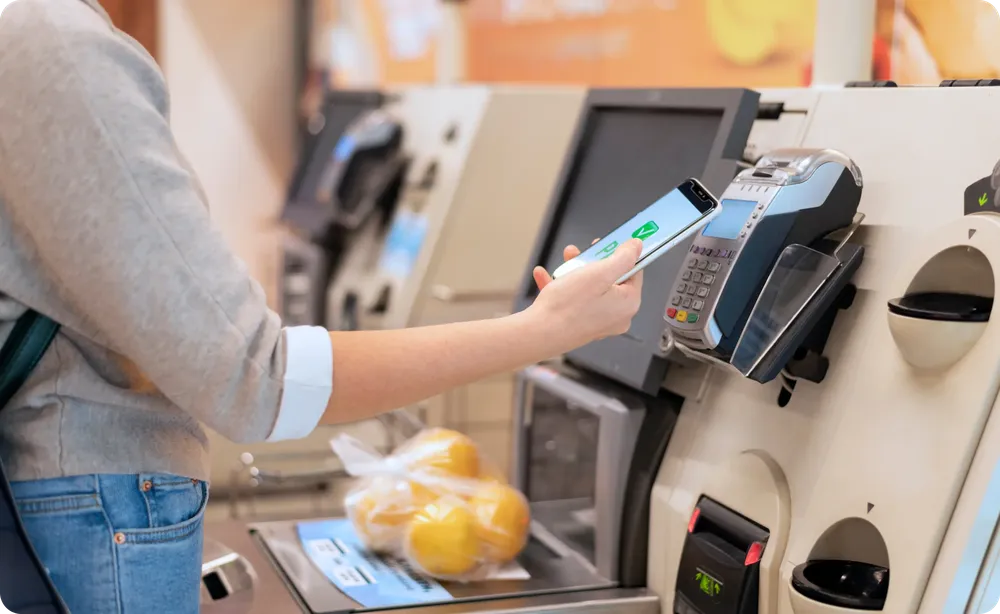
The first thing people point out as a con to autonomous stores is technology – “customers aren’t ready for this” is often the easiest excuse to reach for. But evidence proves otherwise.
At this point, self-checkout has become a default retail behaviour. In Germany, fixed self-service checkouts grew 143% over two years, and the country now runs over 38,000 self-checkout systems, roughly one in every 18 checkouts nationwide. Consumer willingness to use it climbed from 56% to 67% of shoppers in the same period, and 71% of shoppers under 24 say they often choose the self-checkout lane.
At the same time, Capital One Shopping puts the global self-checkout market at $6.89 billion in 2025, projected to reach $13.5 billion by 2030, with 96% of US grocery stores now offering it and close to 80% of consumers using it regularly.
Fast food normalized the same behavior from the other direction. McDonald's introduced self-order kiosks in the early 2000s, and the habit has since proven itself: kiosk users spend 10 to 30% more per order than they do at a staffed counter, while Panera saw an 11.5% sales lift after rolling them out. Interestingly, kiosk adoption among quick-service restaurants overall still sits at only around 10%, well behind grocery's near-universal self-checkout.
But that gap is about restaurant economics and rollout pace, not customer hesitation. Once someone has tapped through a McDonald's kiosk or scanned their own groceries, walking into a store with cameras instead of a till is not a cognitive leap. The screen was never the wall.
If the interface isn't the barrier, the real variable is context: who is walking past, how often, and under what conditions. A quiet residential street doesn't generate enough of the right kind of foot traffic to make an autonomous format worth its cost. An airport does, because people are moving through it constantly, at every hour, often well past the closing hours of the usual shops.
Zippin has built its checkout-free stores into airports that share the same closed, high-frequency profile: JFK Terminal 4, Rio de Janeiro's Galeão, and DFW. But its heaviest growth lately has gone elsewhere – into stadiums and arenas – the same kind of closed, high-frequency venue as an airport gate. Amazon shows the same split within one company: while it was shutting down its public Go and Fresh stores, it kept quietly expanding Just Walk Out on university campuses in the background (EdTech Innovation Hub). The same company, the same technology, thriving on a closed campus and failing on an open street.
Retail Technology Innovation Hub has documented the same split across the wider industry: checkout-free vendors are succeeding in stadiums and "micro markets" like offices and closed campuses, and struggling in open convenience and grocery formats.
What the winning formats share is a burst of captive, time-pressured demand: people show up in a hurry, with nowhere else nearby to go instead. Think of a stadium during halftime, or an office kitchen between back-to-back meetings. That's exactly the customer autonomous checkout is built for, someone who wants to grab something fast and get back to what they were doing.
Thankfully, companies have more wiggle room to adjust their business models and combine the best of both worlds.
Żabka's store on Wolska Street in Warsaw, open since October 2023, runs as a normal staffed shop from 6am to 11pm, till and self-checkout included, then switches to AiFi's vision-based autonomous checkout from 11pm to 6am, when customers get in with a bank card or the Żappka app and simply walk out with what they picked up.
Bünting runs a close variant at its Combi City store in Emden, Germany. It's staffed Monday to Saturday, 8am to 6pm, then switches to unstaffed hours from 6pm to 11pm and again from 6am to 8am, when customers get in with a bank card or the retailer's own Moin Card. A cloud system called Wanzl Connect watches access, lighting, and shopper behaviour during those unstaffed hours.
The logic behind both is simple. During busy hours, when a store has steady traffic, having a person behind the counter is still better for handling problems, building trust, and providing a visible presence. At night, when fewer customers come in and staffing a store becomes expensive, an autonomous system can keep the doors open without the cost of a night shift. It also gives customers time to get used to the new technology, while a human is still there to help during most of the day.
On the downside, autonomous retail doesn't necessarily reduce costs. The potential savings – labor, checkout infrastructure, and day-to-day staffing – can quickly turn into expenses elsewhere. Trigo, a cashierless technology vendor, admits as much: setup "can be expensive" because of the advanced hardware and software involved, including AI systems, sensors, and high-resolution cameras.
Even Amazon ran into this. When it pulled the same Just Walk Out technology from its own US stores in 2024, IDC analyst Matt Arcaro named the specific cost drivers: "the required cameras, back-end computing devices, and weighted shelving," calling the up-front cost "untenable for a lot of companies, even Amazon and their deep pockets".
The economics depend heavily on local wages, store traffic, shrinkage, and how well the technology actually performs. Autonomous is a different cost structure, not automatically a cheaper one.
The evidence points the same way: checkout-free technology works, reliably, when the format matches the place. A location with controlled access, predictable traffic and a captive audience rewards full autonomy because the customer has already accepted the friction of being there. A location competing head-on with the corner store the neighbourhood already trusts punishes it, because every extra step becomes a reason to keep walking.
The retailers who keep getting burned are the ones betting technology alone will win the format. The ones getting traction are matching staffed, autonomous or hybrid operation to how predictable a location's demand actually is, and letting that decision, not the novelty of the tech, drive where they build.

J. Nawrocki - Lead UX Researcher

K. Szmaj - VP of Strategy & Design

I. Franke - Head of Advisory

K. Borowiec - Business Development Manager