Marcin ZduńczykBusiness Solutions & Customer Data Architect
BusinessStartupsMobile Development
Dec. 24, 2025 10 min
read
What Are the Key Steps to Take Before Starting Mobile App Development?
Emil Waszkowski
VP of Strategic Initiatives
The decision to start a mobile app development project often feels like the most critical moment. In reality, the most impactful phase is the pre-development planning. This period, often calledDiscovery and Definition, is where you define the product's value, secure the necessary budget, and establish the technical guardrails that prevent scope creep and technical debt.
As a Product Owner, your goal isn't just to launch a product, but to launch a high-quality product that helps meet your KPIs. Achieving that requires completing Future Mind’s ten-step strategic checklist focused on minimizing risk and maximizing value before the first line of code is even written.
TL;DR: the Product Owner’s pre-launch checklist
Starting mobile app development is a high-stakes investment. As the Product Owner, your focus must be on mitigating risk and ensuring a tight definition of value.
The critical steps are:
Validate the problem (Concept & Market): do not build a solution looking for a problem. Conduct competitor analysis and proof-of-concept testing to confirm demand.
Define the boundaries (MVP Scope): translate user needs into a tight, non-negotiable Minimum Viable Product (MVP) scope using tools like User Stories and MoSCoW.
Secure the Total Cost of Ownership (TCO): budget not only for development but also for crucial post-launch factors: maintenance, infrastructure, and marketing.
Select the right partner: choose a technology partner based on their methodology and their ability to act as a strategic advisor in the Discovery phase.
10 Things to do before developing a mobile app
The following steps frame the pre-development phase as a sequence of risk-reduction and value-definition activities, essential for any successful Product Manager.
1. Conduct a feature-focused competitor analysis
A competitor analysis is not just about surveying the landscape; it is about identifying feature gaps and confirming user pain points. As a Product Manager, you need to turn customer feedback from your competitors’ app store reviews and forums into actionable insights for your backlog.
Analyze competitor reviews to determine:
Must-have features: what features are universally praised and considered standard for this market? These form the baseline of your MVP.
User frustrations: What features are competitors lacking or executing poorly? These represent your immediate opportunity to deliver superior value and form the core of your Unique Selling Proposition (USP).
This process allows you to polish your business model and ensures your initial feature set directly solves known problems, rather than assuming new ones.
2. Define actionable user personas
User personas are the foundation of your product backlog. Instead of abstract demographic profiles, use personas to drive your user story definition. A well-defined persona immediately informs feature prioritization and functional design.
The core output here is a set of precise User Stories. Use the format: “As a [Persona], I want [Goal/Feature] so that [Value/Reason].” This shifts the discussion from technical requirements to business value, providing clarity for the development team and stakeholders alike.
3. Validate the concept and secure MVP buy-in
Before committing resources, you must validate that the market is willing to pay for or actively use your proposed solution. This concept validation is crucial for securing budget and stakeholder alignment.
The practical approach is to build a high-fidelity Proof of Concept (PoC) or launch a low-friction landing page. The goal is to measure user intent through:
Email sign-ups: track the number of leads willing to share their contact information for beta access or launch updates.
Pre-launch commitment: if applicable, gauge willingness to pre-order or commit to a paid plan.
This evidence acts as an indisputable argument for moving forward and is far more reliable than internal enthusiasm.
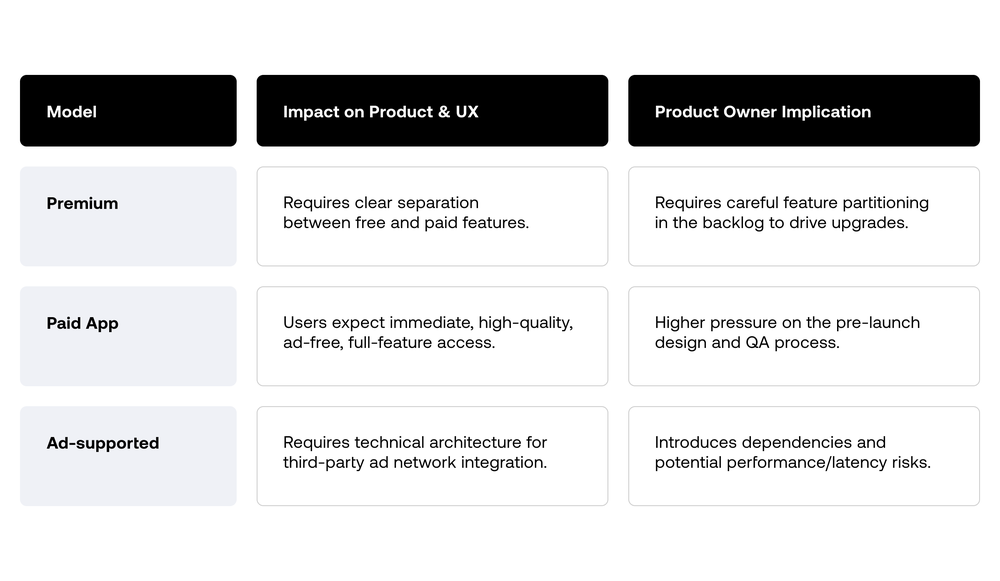
4. Choose the monetization strategy wisely
The monetization model is not a marketing afterthought; it is a structural decision that fundamentally impacts your User Experience (UX) and technical architecture.
5. Establish measurable product KPIs
Projects fail when success is defined vaguely. As Product Manager, you must establish clear, product-specific KPIs that link development effort to business outcomes. Avoid vanity metrics and focus on those that reflect actual user engagement and value.
When you’re contacting a technology partner, tell them about all the necessary application features and, above all, define its purpose clearly. It will make understanding your vision and creating a plan to make the product that fully meets your needs much easier for the product team.
There are similar solutions on the market already? That’s even better – show them to your team and explain how your product will differ from the competition. The more details, the better. This will help them understand the subject, plan the application development process and evaluate its scale.
6. Finalize the product specification: user stories and prototypes
A formal, detailed specification is the single most effective tool for avoiding scope creep and getting an accurate cost estimate. In an agile context, this means finalizing your functional requirements before development begins.
Today, AI tools can dramatically accelerate this phase – generating user stories, proposing information architecture, creating first-pass prototypes, and even identifying gaps in requirements. What once took weeks can now be compressed into days.
How are UX and AI getting along today? Better than ever. Figma Make has changed the pace of prototyping - from weeks to hours - and users consider such mockups twice as reliable. At the same time, Figma MCP bridges design and development: from a well-prepared design system, it can now generate code that only requires minor adjustments. LLMs synthesize research results and deliver clear insights from content-rich reports. AI writes UI documentation, describes accessibility rules, and performs QA, while designers, freed from repetitive tasks, can focus on what truly matters.
Łukasz Okoński,
Head of Product Design at Future Mind
Key deliverables at this stage are:
Clickable prototypes: visual representations that allow users and stakeholders to test information architecture and flow.
Functional specification: a document detailing what the app must do, including edge cases and integrations.
If your team lacks the resources for this, seek a partner offering dedicated Product Discovery Workshops. This investment ensures that both the internal team and the software house have a shared understanding of the deliverables and effort required.
7. Determine the Total Cost of Ownership (TCO)
A successful budget extends far beyond development time. Your TCO must factor in all expenses to ensure the product's long-term viability and growth.
Key costs to factor in:
MVP Development: the initial build, typically priced on a Time & Materials (T&M) model for maximum flexibility in an Agile environment.
Post-launch maintenance: bug fixes, OS updates, and library upgrades: a non-negotiable, continuous cost.
Infrastructure: server costs, database hosting, and scaling solutions.
Marketing & ASO: budget for promotion (often comparable to the development cost) and App Store Optimization.
Ignoring maintenance and infrastructure costs in the initial budget is a direct path to accumulating unavoidable technical debt.
8. Choose the right partner
When evaluating a technology partner, prioritize their process and strategic fit over a low fixed price. For innovative projects, the Agile methodology combined with a T&M contract is generally recommended, as it allows for course correction and feature pivoting based on real-world user feedback.
Look for a partner who:
Has strong Digital Advisory capabilities: they should challenge your assumptions, not just take orders.
Understands the full ecosystem: if your mobile app requires a web admin panel, look for a partner proficient in both mobile and web development (full-stack capability).
Provides transparency: ensure they use standard Product Owner tools like Jira and Confluence for transparent backlog and progress reporting.
9. Integrate the promotional strategy early
App Store Optimization (ASO) and marketing are not parallel tasks; they are requirements that must feed back into your product backlog.
ASO integration: the titles, descriptions, and screenshots you use in the App Store and Google Play are informed by your competitor analysis (Step 1). Ensure the development team adheres to technical requirements for fast loading times and stable performance, both of which are major ASO ranking factors.
Defining the USP: work with your marketing team early to define the Unique Selling Proposition (USP) – the single sentence that immediately explains your app's value. This clarity impacts everything from design to onboarding.
10. Prioritize post-MVP development and technical debt
Launching the MVP is just the midpoint. The final step is establishing the product culture of continuous discovery and effective technical debt management.
You must build a process for continuous monitoring and iteration, driven by the KPIs defined in Step 5. Crucially, the Product Manager is responsible for allocating resources to address technical debt. This is the maintenance and refactoring work required to keep the app scalable and performant. Neglecting it will slow down future development sprints, increase costs, and ultimately compromise the quality of the product you manage.
Want to build an app but don’t know where to start? Don’t hesitate to drop us a message at [email protected]. We’re always happy to help!
Frequently Asked Questions
1. Why is pre-development planning so important for mobile apps?
Pre-development planning helps clarify your app’s goals, target users, and key features. It reduces the risk of scope creep, avoids costly rework, and ensures that both your team and development partners share a clear understanding of requirements. A well-prepared plan sets the foundation for a smoother, faster, and more predictable development process.
2. How long does the pre-development phase usually take?
Typically, a discovery phase can last anywhere from 2 to 6 weeks, depending on the app’s complexity, number of stakeholders, and market research needs. Using AI-assisted tools for prototyping and requirement gathering can reduce this timeframe significantly, sometimes compressing tasks that used to take weeks into just a few days.
3. How much does it cost to prepare for mobile app development?
Costs vary depending on the depth of research, number of workshops, and level of documentation required. A typical pre-development phase can range from a few thousand to tens of thousands of euros. Investing in proper planning upfront usually saves more in development costs and reduces the risk of expensive iterations later.
4. How detailed should the product specification be?
The product specification should clearly define functional requirements, edge cases, user flows, and integrations. Prototypes are highly recommended to visualize the user experience. The goal is to ensure everyone understands exactly what will be built.
5. What is a Product Discovery Workshop and do I need one?
A Product Discovery Workshop is a collaborative session that helps define your app’s goals, features, and user journey. It aligns stakeholders, uncovers hidden requirements, and validates assumptions before development begins. If your team lacks the resources or expertise to do this internally, hiring a partner such as Future Mind to run such workshops is highly recommended.
6. How can AI tools speed up early planning and prototyping?
AI tools can help generate user stories, suggest flows, create prototypes, and even spot gaps in requirements. This accelerates the discovery phase, reduces manual effort, and allows your team to iterate faster; moving from concept to validated designs in days instead of weeks.
Frequently Asked Questions: Mobile App Development
Why is the pre-development phase so critical for a mobile app project?
Because the most expensive mistakes happen before the first line of code. Discovery and Definition is where you validate the problem, set the MVP scope, and put guardrails in place to prevent scope creep and technical debt. As Product Owner, your job here isn't to ship features – it's to mitigate risk and tighten the definition of value. Teams that skip or rush this phase tend to deliver an app that ships on time and then fails to meet KPIs. Teams that invest here ship slower at first and dramatically faster afterward.
How do you validate a mobile app concept before investing in development?
Don't trust internal enthusiasm – it's the cheapest signal you can buy and the most misleading. Instead, build a high-fidelity Proof of Concept or a low-friction landing page that lets you measure real user intent. Track email sign-ups for beta access, pre-launch commitments, willingness to pay. Combine that with a focused competitor analysis: review app store ratings, forums, and feature gaps. The goal is to walk into the kickoff with evidence – not opinions – that the market wants what you're about to build.
What goes into a proper Minimum Viable Product (MVP) scope?
Three things. First, user stories grounded in well-defined personas: "As a [persona], I want [feature] so that [value]." Second, a prioritization framework (MoSCoW works well) that forces you to separate must-haves from nice-to-haves. Third, clickable prototypes that let stakeholders test flows and information architecture before development starts. The MVP scope is not a wishlist – it's the minimum set of features required to validate the value proposition. Done well, it's the single most powerful tool for preventing scope creep.
What costs should be factored into the Total Cost of Ownership of a mobile app?
Way more than the initial build. TCO covers: MVP development (often best on a Time & Materials Agile contract for flexibility), post-launch maintenance (bug fixes, OS updates, library upgrades – non-negotiable and continuous), infrastructure (servers, databases, scaling), and marketing including App Store Optimization (often comparable to development cost). Underbudgeting any of these is a direct path to technical debt and underperformance. The apps that thrive in year three are the ones whose budgets accounted for years two and three from day one.
How do you pick the right technology partner for a mobile app project?
Look beyond a fixed-price quote. Prioritize partners who challenge your assumptions instead of taking orders, work in Agile + Time & Materials (because requirements will evolve), provide transparency through tools like Jira and Confluence, and have full-stack capability if your app needs an admin panel or web counterpart. Strong Digital Advisory capabilities matter more than raw development speed – the best partners shape the product, not just deliver it. Future Mind runs Product Discovery Workshops to make sure you and your delivery team share the same definition of success before development starts.